 http://barefoot-em.com/swims/an-early-morning-swim-at-the-edwardian-bramley-baths/
HUB-IN Interviews | Talking Community Businesses
HUB-IN Interviews: A focus on the Financing Models for Historic Urban Area (HUAs) projects
Novel opportunities emerge as the heritage regeneration financing landscape evolves. When looking at past and current projects, financing comes predominantly from classic public and private funding sources. Yet as we will discover that crowdfunding and community funding are increasingly becoming a part of the funding mix.
HUB-IN Places dare to experiment with new financial structures, combining traditional public funding streams with other (private) sources of funding. In creating novel financial structures, HUB-IN cities carefully balance potential shifts in the distribution of power and influence, contributing to their city’s inclusive and sustainable development.
Today’s Expert: Richard Harries from Power to Change

Richard Harries – Former Director of R&D, Power to Change Trust.
Power to Change : Independent charitable trust that uses strategic funding, trusted partnerships, rigorous research and policy insight in order to strengthen community businesses and tackle some of society’s biggest challenges at a local level, including three of the biggest current challenges: the climate crisis, digital transformation and social inequalities.
How are community businesses financed and how does Power to Change make investments?
At Power to Change we provided fairly large capital investments. When looking at the application we mainly looked at the strength of the business case, not at what we might think is best for the community, we know they know that better than us. Community businesses do use local funding and crowdfunding. The use of community shares allows the community to own a part of the business. Since 2012 over 100.000 people have raised over 150 million pounds. Each shareholder has one vote, independent of how many shares they own. This enables democratic local ownership. In a previous program supporting community pubs, there was a small bursary to get the community started, followed by a much larger grant to support the asset transfer process. To our surprise, many groups did not take the second grant but opted for community shares instead. This shows their entrepreneurship – not waiting for the grant, but moving on by themselves. Read more information about community shares.
Can you give us an example of a community business?
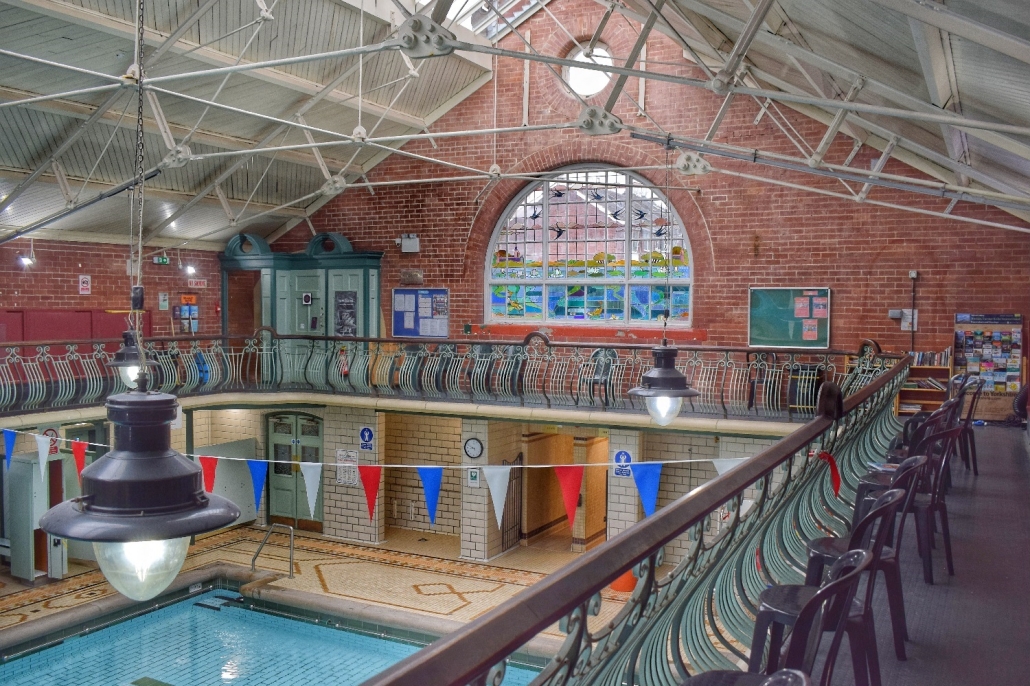
Ten years ago in Leeds the council decided to close a swimming pool and leisure centre, originally built in 1908 and including a Russian steam room. It was much loved by the local community but the council was losing a hundred thousand pounds a year running it. The community said they would like to try to take over the centre and run it. The council then said they would find savings elsewhere to keep the building open, but the community said “no, we will do it”. They have been running it successfully for 10 years now, in part through the use of volunteers alongside the necessary professional staff, but also because they are very entrepreneurial. They run an ‘underwater cinema club’ and support local art shows. There is nothing they do that the council couldn’t have done but it is different if it’s owned by the local community. This is a pattern we see over, and over again. It’s not about doing things ‘better’ but about doing them differently. Community libraries are a similar example. The volunteers who run them are mad about books and libraries, and that energy helps them to find creative ways to generate the income they need.
What is the role of community businesses in urban heritage regeneration?
Community businesses are an ideal form for urban heritage regeneration. The physical connection of local people to a place is very powerful. There is a good example in Birmingham. The local community business operated out of premises right next to a beautiful Church of England building. One quarter is still a working church, the rest is an activity centre. The council could not run it and asked the community business to take over. However, they don’t own the asset and so cannot raise money to renovate it. Now it is getting worse and worse. All that needs to happen is to properly transfer the lease to the community business. But it is in no one’s particular interest to make it happen – not the council, not the Church of England. Yet if you can get the finances and the legalities right, transferring assets to community businesses can be transformational.